Published: 11/11/2026
By Catherine Wu, Global Health Communications Assistant
Human health has improved dramatically over the past two centuries. When Steve Luby, MD, began his work in global health, nearly one in 10 children worldwide died before turning five. Today, fewer than one in 20 do. The average life expectancy at birth has increased dramatically as well, from 29 in 1800 to 73 in 2016.
“How did we improve?” Luby asked his audience at a Global Health Fall Research Spotlight lecture on Nov. 3. “What changes global health?”
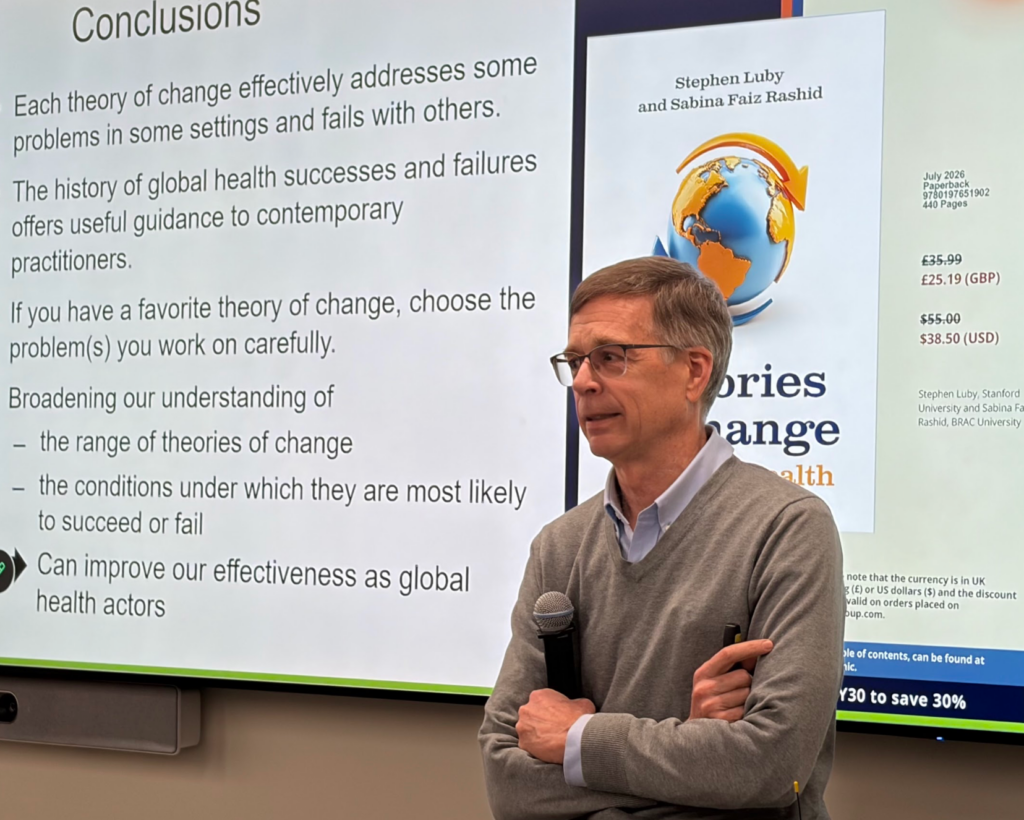
Each possible answer — whether vaccination initiatives, stronger health systems, or economic growth — is what Luby calls a “theory of change”: a belief about what it takes to make a population healthier. In their new Oxford University Press textbook, Theories of Change in Global Health, Luby and co-author Sabina Rashid examine 15 such theories, sharing examples of when they worked and when they failed — and examining why.
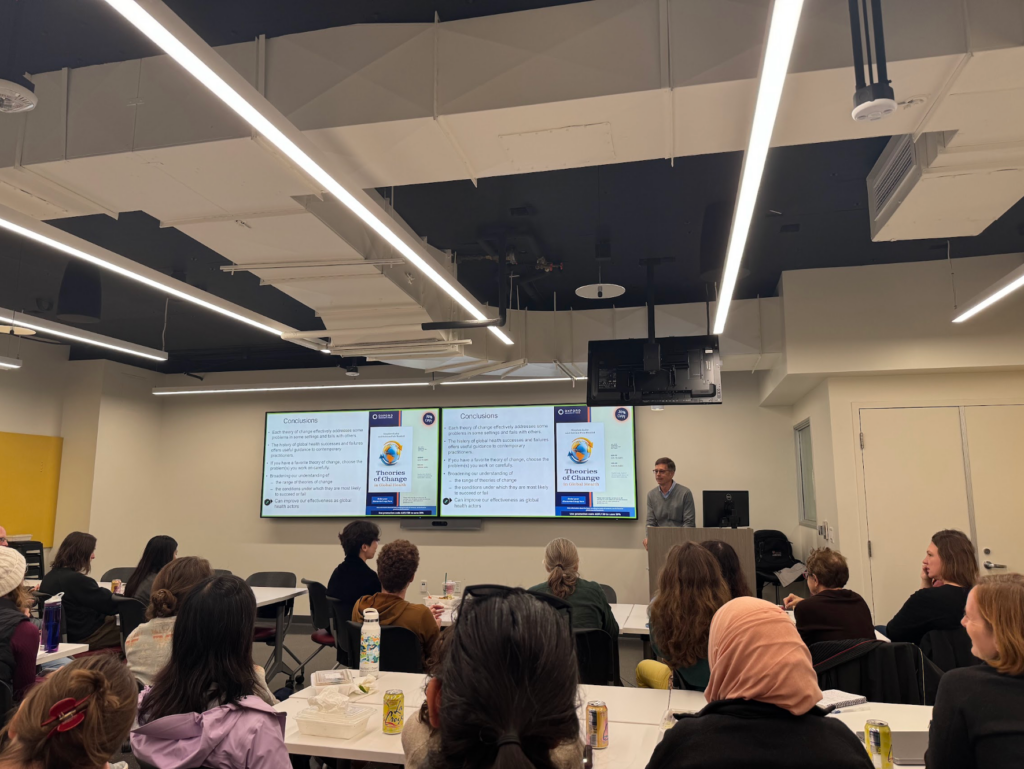
On Tuesday, Luby shared lessons from the book before a packed classroom of 70 attendees at the Research Spotlight event co-hosted by the Stanford Center for Innovation in Global Health (CIGH) and the Stanford Center for Human and Planetary Health (HPH). Drawing on more than a decade of work in Pakistan and Bangladesh, Luby, who is the Lucky Becker Professor of Medicine, director of HPH, and research director at CIGH, argued that studying why some global health efforts succeed and why others fail can offer valuable guidance for researchers, global health organizations, and funders as they choose where to invest their time and money.
“Global health is not just about generating new knowledge,” Luby said at the Global Health Fall Research Spotlight. “Global health is about trying to improve the world.”
Luby has dedicated his career to improving health in low-income communities, working for years in Bangladesh and Pakistan alongside local researchers. In the process, he observed repeated barriers such as poverty, exploitation, violence, ignorance, corruption, pollution, and weak governments. Medical schools and epidemiology training seemed to barely cover these challenges, Luby noted, and the organizations that were trying to solve them often seemed to work ad hoc.
After thinking for over a decade about theories of change in global health, Luby launched a Stanford course in 2016 to explore these ideas further — SOMGEN 207/ INTLPOL 291: Theories of Change in Global Health. He also began thinking about a book. Over the next four years, students in Luby’s class critiqued his draft chapters and pushed him towards more robust case studies.
The book features 15 theories of change, including: strengthening health systems, passing health regulations, cash transfers, changing prices, advocacy, and strategic research. Real-world problems are also inextricably tangled up with poverty, climate, conflict, and markets. Luby argued against trying to fix everything at once.
“We don’t attempt to alter the entire system. The system is too complex,” Luby said. “Rather, we try to focus on a key area that will generate system-wide benefits.” Drawing on Justin von Levig’s law of the minimum, Luby argued that if one can identify and address the limiting constraint, then it becomes unnecessary to remake the whole system.
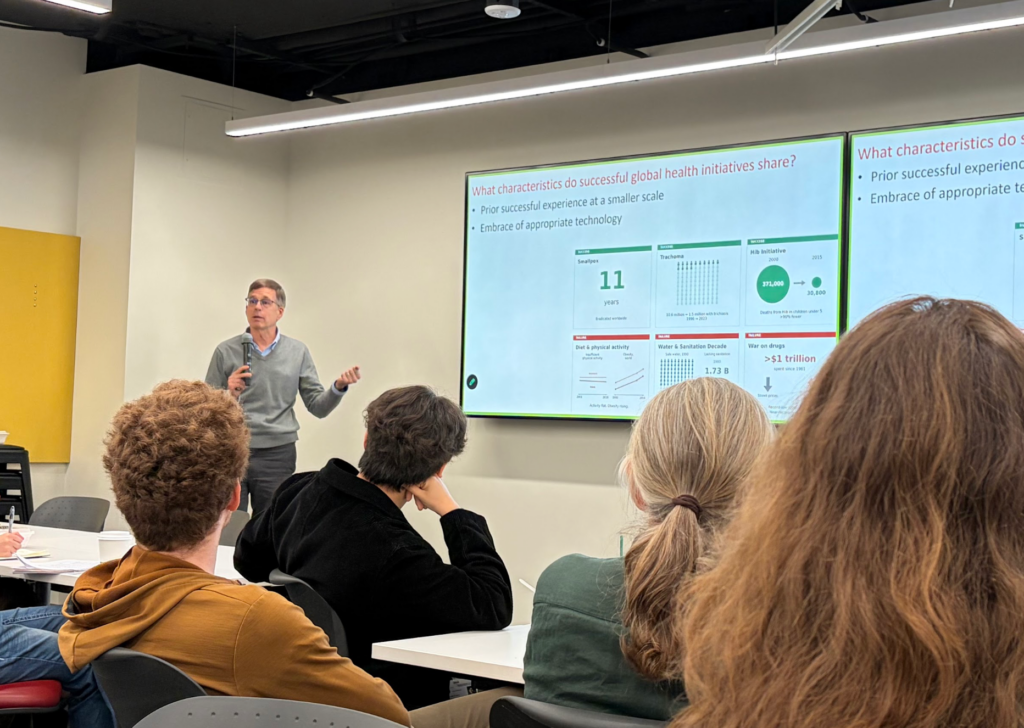
In the book, Luby discusses both successes and failures. In the chapter that explores global health initiatives as a theory of change he noted that successful initiatives smallpox eradication, trachoma elimination, and the HiB Initiative — all shared a common factor of achieving earlier success at local or national levels, before attempting global expansion, as well as careful outcome tracking, openness to revision, and adequate funding. These contrasted with global health initiatives that failed including the Global Strategy on Diet and Physical Activity and the War on Drugs. He emphasized that even well-funded, long-running initiatives can be considered failures if they don’t measurably improve health or are not scalable or sustainable.
Luby cautioned against favoring any one approach without closely analyzing the context first. “Each theory of change effectively addresses some problems in some settings and fails with others,” he said. “There’s no panacea here.”
CIGH Director Michele Barry shared a closing sentiment about Luby’s work: “I introduced Steve as a man with big ideas, and I think what we’ve seen in this book and this lecture are ideas that really are disruptive and change the world,” she said.