Published: 06/04/2026
A new CIGH-sponsored rotation site, at Kandy National Hospital and the University of Peradeniya in Kandy, differs from other global rotations because it focuses on providing medical education, rather than clinical care.
“This is in response to the needs of our Sri Lankan partners,” says Dr. Cybele Renault, MD. Renault is a clinical associate professor of medicine – infectious diseases and leads global health programs for Stanford’s internal medicine residency program. “Given its focus on medical education, the Sri Lanka rotation is ideal for our residents who are passionate about teaching.”
Such was the case for internal medicine residents Drs. Shyon Parsa and Eduardo J. Pérez-Guerrero, who spent about six weeks in Sri Lanka in January and February of 2026.
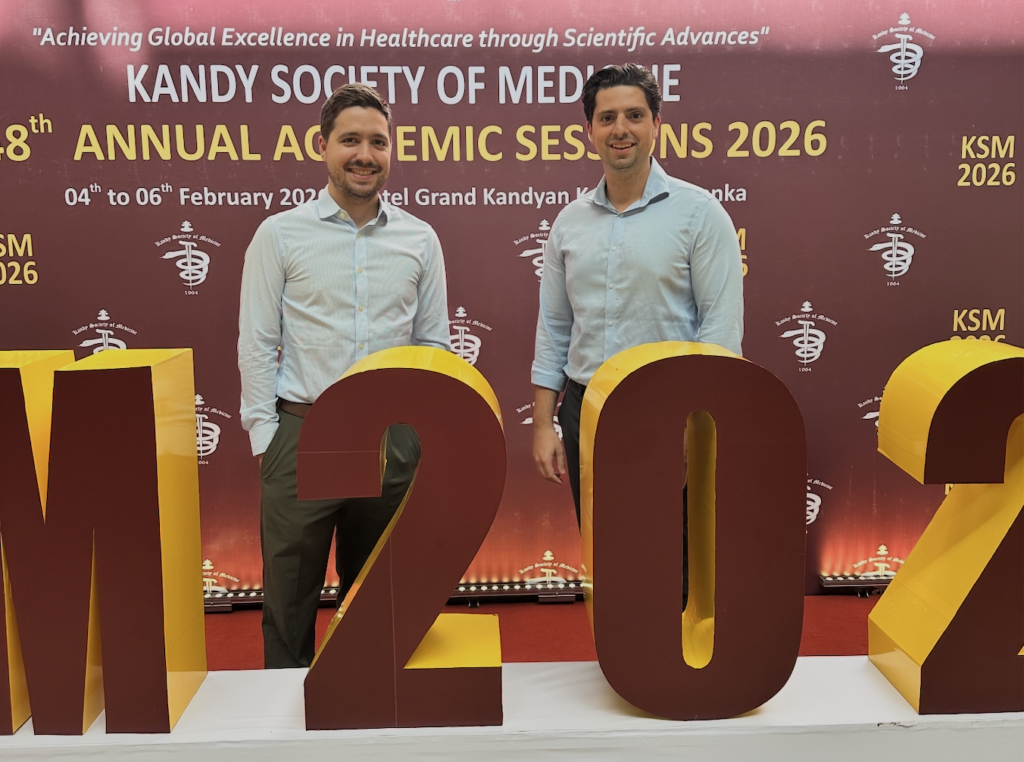
Parsa and Guerrero worked alongside medical students and residents on the general medicine wards at Kandy National Hospital, participating in bedside teaching, presenting unique cases, and leading classes within a high-volume clinical environment.
“While the healthcare setting differed in workflow and available resources, what felt familiar was the culture of learning and mentorship that paralleled our experience at Stanford,” Parsa said. “Students were deeply engaged, eager to ask questions, refine their clinical reasoning, and grow into thoughtful future physicians.”
Parsa and Guerrero also gained valuable insights about healthcare delivery from their time working in the general medicine wards.
Parsa shared the following reflection.
Reflections from Sri Lanka
By Shyon Parsa, MD
My first morning on the general medicine wards at Kandy National Hospital began with a scene very different from Stanford wards. Instead of private rooms and quiet hallways, the ward was a large open room filled with rows of beds. Patients were separated by only a few feet, family members stood beside them assisting with daily tasks, and additional patients waited just outside the ward. The volume was striking. Morning rounds moved quickly, with dozens of patients seen by each team, but with a remarkable balance of workload and efficiency.
Despite the pace and limited space, what stood out most was the attentiveness of the physicians. The physical exam played a central role in nearly every encounter. Diagnostic imaging and bedside ultrasound were used more selectively, mostly because of time constraints or limited availability. MRI studies could take weeks to obtain, and cardiac catheterization was generally reserved for clearly emergent cases. As a result, clinicians relied heavily on careful history-taking, physical examination, and clinical reasoning. Watching experienced physicians synthesize complex cases using primarily bedside information reshaped my concept of “doctoring.” I was reminded that medicine at its core is not defined by technology, but by thoughtful clinical judgment and human connection.
One of the most challenging ethical issues I encountered involved the constraints of resource availability. In one case, a patient presenting with myocardial infarction required coronary angiography. However, because catheterization resources were limited and scheduled procedures were performed only on specific days, the patient ultimately received medical therapy rather than urgent catheterization. In the United States, such a patient would almost certainly undergo invasive evaluation immediately. The experience forced me to confront an uncomfortable reality. Even when physicians know the ideal treatment, systemic limitations can shape what care is possible. I also saw how economic factors could influence care in subtle ways despite the presence of a universal healthcare system. For example, one patient with deep vein thrombosis required long-term anticoagulation. While a direct oral anticoagulant would have simplified her care, she could not afford the modest copayment, equivalent to less than one U.S. dollar a month. Instead, she was started on warfarin, a medication requiring frequent monitoring and significant lifestyle adjustments. These moments made clear how medical decision-making often occurs within the constraints of larger structural realities.
One patient story in particular remains vivid in my memory. A man was admitted with severe dengue fever complicated by pulmonary edema and bleeding, requiring close monitoring in a high-dependency unit. His condition stabilized, and he was eventually discharged home. Shortly thereafter, however, he returned with worsening shortness of breath and abdominal pain. Due to numerous complications, he ultimately required surgical valve replacement.
What struck me most was not just the complexity of his illness, but his reaction to it. Despite the complications he endured, he remained deeply appreciative of the physicians caring for him. One attending explained to me that patients and physicians have a unique relationship in Sri Lanka. Despite medical mistakes, patients believe their physicians are acting in their best interest, and that trust shapes the entire therapeutic relationship. Watching the patient express gratitude to the very team that had cared for him through a complicated and imperfect course was moving. It reminded me that trust and compassion can be as powerful as any intervention we offer.
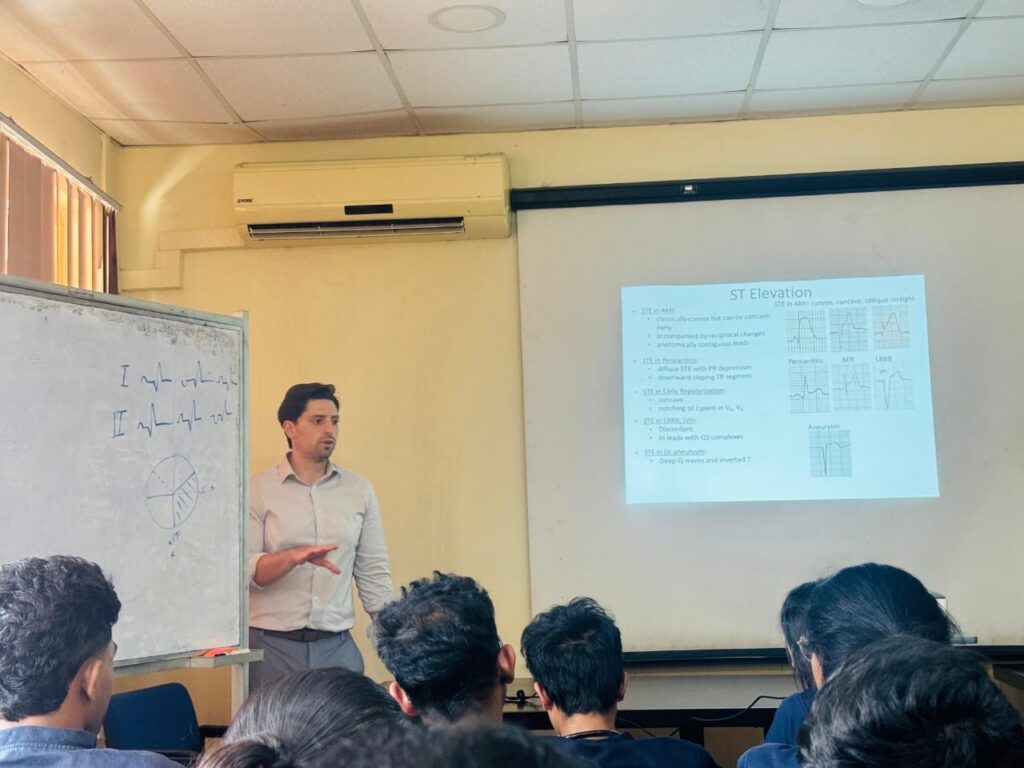
Another meaningful aspect of the rotation was working closely with Sri Lankan medical students. Initially, many of them were hesitant to answer questions on rounds, worried about making mistakes in front of their attendings. However, once conversations became less formal, their curiosity and enthusiasm became clear. They frequently approached me after rounds to discuss cases, review differential diagnoses, and ask about training in the United States. Their dedication to learning, even in an environment with heavy patient volume and limited teaching time, reinforced the universal drive among medical trainees to grow and improve.
Ultimately, my experience in Sri Lanka reshaped how I think about medicine and the role of a physician. The clinicians I observed delivered excellent care under circumstances that required long hours, adaptability, and constant reprioritization. Yet even within these constraints, they maintained kindness, humor, and genuine connection with their patients. A simple touch on the shoulder or a brief joke during rounds often changed a rushed encounter into a meaningful interaction.
While technology and resources undoubtedly improve our ability to diagnose and treat disease, at its core, medicine is about caring for patients as individuals and doing the best we can with the tools available to us. Witnessing the dedication and compassion of physicians in Sri Lanka reaffirmed for me that the fundamental responsibility of a doctor remains the same regardless of country, system, or resources: to place the patient first and to serve them with humility, skill, and empathy.