Published: 04/22/2026
By Catherine Wu, Global Health Communications Assistant
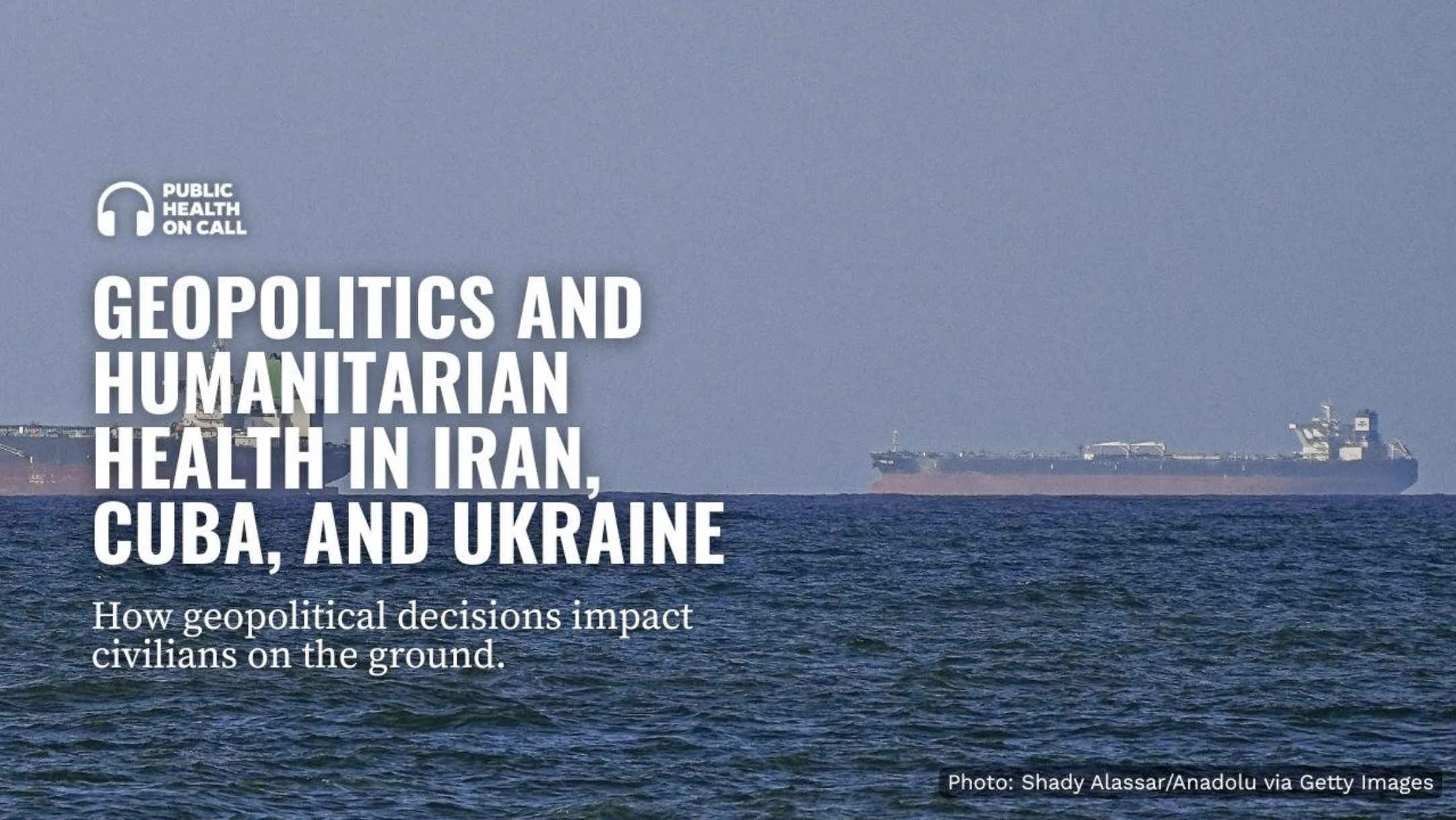
On an episode with the Johns Hopkins Bloomberg School of Public Health’s Public Health On Call podcast, CIGH affiliate Ruth Gibson detailed how geopolitical decisions impact civilians on the ground, as seen in current situations in Iran, Cuba, and Ukraine. For this episode, Gibson talked with host Dr. Josh Sharfstein, distinguished professor of the practice in Health Policy and Management at Johns Hopkins, pediatrician, and former secretary of Maryland’s Health Department.
“Geopolitical decisions are the largest forces shaping the lives of people on the ground,” Gibson said. “My PhD and my postdoc at Stanford [is] to study those questions: the links between big geopolitical forces and literally what can happen to an individual, to a family, to a child thousands of miles away. That’s what I spend my life studying.”
Gibson described that humanitarian crises — from Iran’s naval blockade to Cuba’s oil and energy blockade — cannot be understood without examining their geopolitical roots. Drawing from her own experience of over a decade’s long on-the-ground humanitarian work, including in Africa and the Middle East, Gibson argued that by linking causes to consequences, researchers can develop policy recommendations before catastrophes to avoid their unfolding.
“The reason why I do my research in this way is to be able to comment upon the driving force behind the humanitarian consequences, to be able to say it is this geopolitical action that is going to cause this humanitarian harm, and if you continue on this path, the humanitarian consequences are likely to be this, and so then I can make concrete policy recommendations,” Gibson said.