Bilingual Health Education for Central Valley Farmworkers: A SWAP Project Reflection by Sou Min Shin
By Sou Min Shin, Stanford Master’s Student, Earth Systems Program
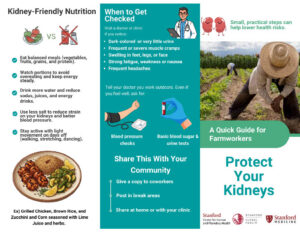
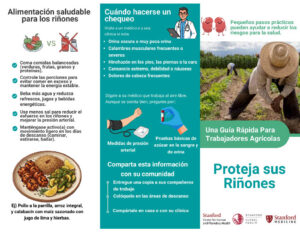
My SWAP project culminated in a bilingual, community-facing health pamphlet titled “Proteja sus Riñones” (“Protect Your Kidneys”), developed in partnership with Ayudando Latinos A Soñar (ALAS) for Spanish-speaking farmworkers in California’s Central Valley and Central Coast. The pamphlet addresses a striking and under-recognized public health problem: farmworkers in the San Joaquin Valley experience end-stage kidney disease at 1.4 times the national median rate, yet most workers remain unaware that their daily conditions — extreme heat, pesticide exposure, and limited healthcare access — are key contributors. Drawing on the academic research I conducted through the SWAP Fellowship and feedback from a community advisory board convened by ALAS, the pamphlet translates peer-reviewed scientific findings into actionable, culturally resonant guidance that workers can actually use: on hydration, diet, recognizing warning signs, and when to seek care.
Community engagement shaped this project in ways I could not have anticipated. Advisory board members confirmed that the visual elements were effective while pushing me toward what I had underweighted such as more visual cues for workers with limited literacy, clearer guidance on safe water sources in the field, and an explicit call to ask physicians for renal function testing by name. They also offered a distribution insight that reoriented my thinking: the most effective pathway into farmworker communities runs through crew leaders and field supervisors, trusted nodes who organize daily work and through whom health information actually flows. The pamphlet is designed to circulate through farmworker associations, community clinics, and social gatherings and I hope it lays the groundwork for a future version that connects kidney health directly to workers’ rights under California heat illness and pesticide exposure standards, a direction the community itself pointed me toward. This project is the work I am most proud of from my time at Stanford, and the most direct expression of the kind of practitioner I hope to be: one who can move between research environments and frontline communities, and who takes seriously the responsibility that comes with translating science for people whose lives depend on it.