Bridging the Gap Between Water Policy and Urban Gardening: A SWAP Project Reflection by Edward Apraku
By Edward Apraku, Stanford PhD Candidate, Environmental and Chemical Engineering Program
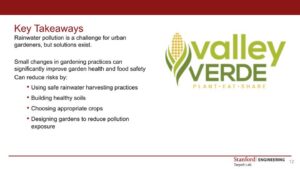
Valley Verde is a San José-based nonprofit that empowers low-income Latino families to grow their own food through urban gardening, but access to safe, affordable water remains a persistent challenge for the communities they serve. My SWAP project aimed to better inform Valley Verde on the policy and environmental considerations surrounding water collection for urban gardening. This took shape across two deliverables: a detailed analysis of the major events shaping California’s water system from roughly 1975 to the present, organized around themes of water quality and regulation, ecosystem restoration, drought, infrastructure, and nutrient recovery; and a presentation examining how collected rainwater affects urban gardening in Valley Verde’s context, with practical solutions for reducing contaminant levels to protect both plant and human health. The presentation has since been shared with stakeholders, and Valley Verde is actively considering the recommendations as they evaluate their water practices going forward.
Looking ahead, I hope to publish or present these findings more broadly so they can be useful beyond a single organization. On a personal level, this project was a deliberate step outside my comfort zone. My PhD keeps me talking mostly with other experts, so I wanted to practice communicating technical research to a non-specialist audience, which is something SWAP genuinely pushed me to do. Working with Valley Verde reinforced for me that good science doesn’t go very far if it can’t reach the people who actually need it, and that’s something I’ll carry with me well beyond this project.