Address the Risk of Schistosomiasis Transmission in Africa: A SWAP Project Reflection by Casey Greene
By Casey Greene, Stanford Student, Biology Program
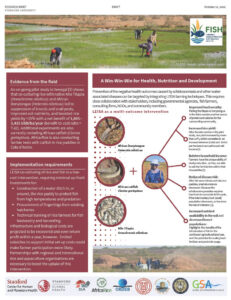
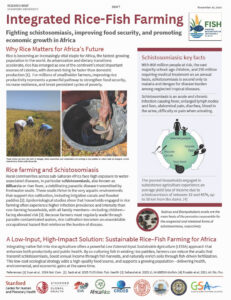
This communication project seeks to address the risk of schistosomiasis transmission in Africa, a parasitic disease that is contracted when contact is made with contaminated bodies of water. Rice paddies provide an ideal habitat for freshwater snails that carry the parasite responsible for schistosomiasis, creating a significant occupational hazard for rice farmers. A fact sheet was generated to help guide stakeholders in helping implement a cheap and effective biological solution for small-scale farms: the introduction of fish, the natural predators of the ‘snail vectors’. Integrated rice-fish farming not only minimizes the risk of contracting schistosomiasis but also improves food security, decreases the need for fertilizer, increases rice yield, and serves as a form of dual production. Thus, farmers not only remain healthy, but their incomes are greatly bolstered by introducing fish into their paddies.
The fact sheet was presented at the Regional One Health Conference for Eastern and Southern Africa in Lusaka, Zambia. There, it was well received with ~30 copies handed out. AfricaRice also verbally agreed to add its logo, and the 2-pager was also used to explain the project to an NPR journalist interested in covering the research and the Stanford news stories on the project. For the next step, I am drafting a “how-to” comic outline to serve as a reference for rice farmers as they begin the process of introducing fish into their paddies. The draft is being made with the intention of serving as a “jump-off” point for further development in collaboration with local artists and students at SIA who have agreed to work on the project.
Working on this project, I have learned more than I ever thought I would– about schistosomiasis, rice, and fish, but also about science communication. The most transformative lesson that I gleaned from the myriad of speakers, as well as Dr. De Leo and Dr. Kauffman, was that for an intervention to be successful, you must have a deep understanding of the community you are trying to help– what they value, who they trust, and how they function. In fact, this understanding prompted me to choose a research project in my PWR 2 class (Writing about Comics) that centered around the effectiveness of science comics as tools in changing human behavior. As I conducted my research, I was motivated to translate what I had learned into a product for SWAP, and luckily, my mentors were on board. I’m grateful to the De Leo lab and the teaching team for their support and flexibility in allowing me to pursue possible solutions, and I hope to apply the knowledge I’ve gained and the skills I’ve learned through SWAP to a future career in science communication.