Published: 10/26/2026
Stanford collaborations with African surgeons are reshaping how surgery is taught and assessed
By Catherine Wu, Global Health Communications Assistant, and Jamie Hansen, Global Health Communications Manager
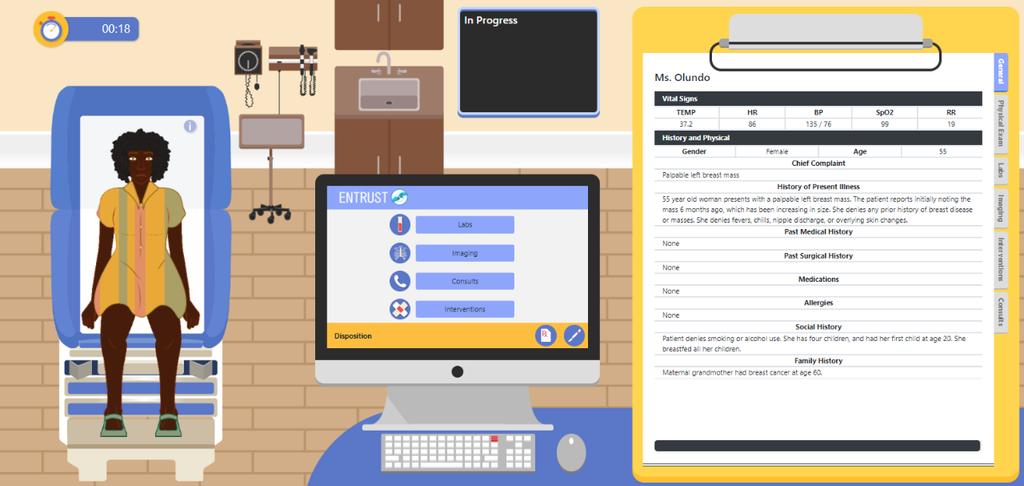
Learning to make sound clinical decisions in high-stakes situations is central to becoming a surgeon. But in many low- and middle-income countries, surgical trainees have few chances to practice those in-the-moment decisions in a safe and risk-free environment. Now, a free and rapidly scaling platform built at Stanford is enabling surgical trainees in 25 countries to learn and be assessed on these essential decision-making skills virtually.
The platform, ENTRUST, was initially built at Stanford and designed to align with the American Board of Surgery’s Entrustable Professional Activities assessments. It was soon adapted for African surgical colleges with mentorship and support from global health leaders at Stanford and in Africa.
“The Stanford Center for Innovation in Global Health (CIGH) is the spark that brought together all of the support and resources to develop numerous impactful, meaningful, longitudinal, bidirectional partnerships and collaborations across the world,” said Cara Liebert, MD, FACS, co-leader of the ENTRUST initiative and a clinical assistant professor of surgery and associate chair of education in Stanford’s Department of Surgery.
A surgical rotation in Zimbabwe sets the foundation for a career in global health
In 2016, Liebert was a general surgery resident at Stanford when CIGH funding enabled her to travel to Parirenyatwa Hospital in Harare, Zimbabwe, to train under Professor Godfrey Muguti. The experience laid the foundation for Liebert’s current academic focus on global surgical education in Africa, she said.
Liebert now helps oversee the same rotation for today’s residents and returns to Zimbabwe yearly to teach laparoscopy, a minimally invasive surgical technique, alongside Muguti.
Liebert’s experience also sparked a passion for bidirectional partnerships that eventually led to the adaptation of the ENTRUST assessment tool as a free, digitally accessible resource for medical trainees in central and eastern Africa.
Filling an important gap in surgical assessments
ENTRUST began to take shape after Liebert returned to Stanford. She and her colleague Dana Lin, MD, FACS, clinical associate professor of surgery, turned their attention to filling a crucial gap in surgical education and assessment that existed in the U.S. as well as overseas.
There were existing tools to assess a surgeon’s technical skills and factual knowledge, but few were available to evaluate their critical thinking and complex decision-making, including weighing patients’ care options, managing complications, and deciding when to operate. Existing methods, such as direct clinical observation and oral board examinations, also placed a heavy burden on overstretched faculty administering the evaluations.
To address these challenges, Liebert and Lin built the ENTRUST Learning and Assessment Platform, an online virtual patient simulation in which surgical trainees work through clinical scenarios and are scored on the decisions they make. They did so in collaboration with Edward Melcer, PhD, a computational media professor at the University of California at Santa Cruz, programmers, user interface designers, and artists.
Adapting a Stanford innovation to meet global need
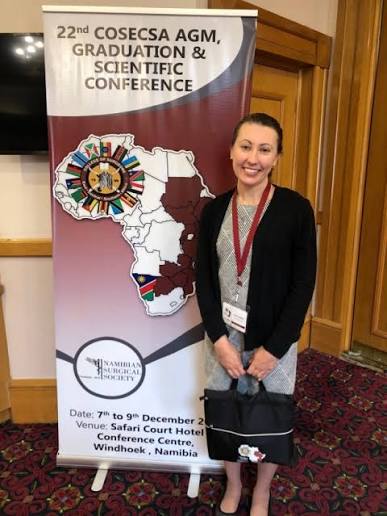
While volunteering to test the platform, Stanford Professor of Surgery and Director of Global Surgery, Sherry Wren, MD, FACS, FCS(ECSA), FISS, was struck by how useful the tool could be for her surgical colleagues in Africa. Specifically, she saw that ENTRUST could provide a creative solution to an examination problem facing the College of Surgeons of East, Central, and Southern Africa (COSECSA) – the largest surgical training institution in sub-Saharan Africa, which advances education, training, standards, research and practice in surgical care in the region.
It was 2021 at the time, and COVID-19 made it impossible for surgical trainees to travel from multiple countries to a single exam site, forcing COSESCA to move to a virtual exam format. Without in-person assessments, in which examiners could watch candidates work through scenarios in real time, it was much harder to assess the fast-paced decision-making that surgery demands. ENTRUST, Wren realized, could help COSECSA overcome these challenges by providing an option for virtual, interactive assessment. Liebert and Lin worked with Professor Abebe Bekele, MD, PhD, to adapt ENTRUST for COSECSA’s needs, piloting three clinical cases during that year’s exam. Bekele was chair of COSECSA’s Examinations and Credentials Committee at the time. He is also a professor of surgery, dean, and deputy vice chancellor of the University of Global Health Equity (UGHE).
ENTRUST was well received as an effective assessment tool, and examinees who used it soon began to imagine other uses for the platform. In 2021, 92% of examinees surveyed said they wanted to use ENTRUST as a surgical learning platform as well.
In 2022, Liebert and Lin received a CIGH Global Health Seed Grant to formalize and extend their work adapting ENTRUST for use in low- and middle-income countries. They also used the grant to build out the self-assessment version of the platform in which trainees could practice clinical scenarios independently and get feedback before their exams. That November, ENTRUST became a formal platform for a portion of the COSECSA examination, replacing the demanding process that had required candidates from numerous countries to travel to a single site.
Partnerships deepen through Stanford African Scholars in Global Health program
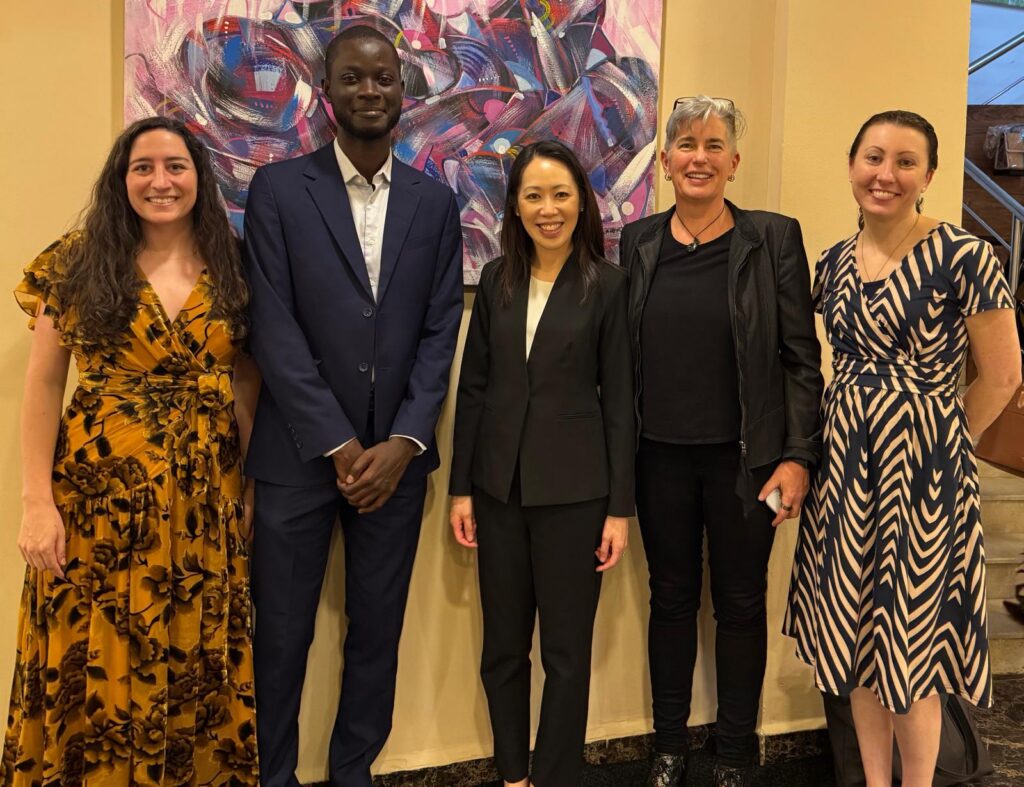
Liebert’s ENTRUST collaborations expanded in 2025 through CIGH’s Stanford African Scholars in Global Health (SASH) program when she mentored two scholars who sought to incorporate ENTRUST into surgical education initiatives within their professional societies and universities: Dr. Kimutai Sylvester of Kenya and Dr. Abdourahmane Ndong of Senegal.
SASH scholar Kimutai Sylvester, a consultant general surgeon and chief of surgery at Tenwek Hospital in Kenya, integrated ENTRUST into COSECSA’s Surgical Foundations curriculum. So far, more than 500 trainees from 20 countries have used the online curriculum.
SASH scholar Abdourahmane Ndong, assistant professor of surgery at Gaston Berger University in Saint-Louis, Senegal, is using ENTRUST’s virtual patient cases to train and assess medical students’ and surgical residents’ clinical decision-making. In 2026, his project trained 25 faculty members and 138 students. Students now take their end-of-rotation examinations on the platform.
“In Senegal, medical students and surgical residents have few structured opportunities to practise clinical reasoning before they face real patients,” Ndong said, adding that surveys of students and faculty have found that key barriers include high cost and weak infrastructure. “ENTRUST gives us a low-cost, scalable way to close that gap.”
“Dr. Cara Liebert and Prof. Sherry Wren have been far more than mentors,” Ndong emphasized, explaining that they worked “alongside us at every step, from training our faculty to running our first ENTRUST-based examinations.”
All this means better care for patients in West Africa, he added.
“Better-prepared trainees ultimately mean safer care for our patients, and together we hope to build a culture of simulation-based surgical training across West Africa,” Ndong said.
In February 2026, Liebert and Ndong attended the annual conference of the West African College of Surgeons in Ghana to share their work and strengthen collaboration with surgical educators from the region.
“These global partners, medical educators, and global health leaders who I have met through CIGH have become a close community of deeply trusted academic partners, colleagues, and friends,” Liebert said.
A growing movement
Today, ENTRUST is used in 25 countries, from Myanmar to England to Saudi Arabia, where Sudanese trainees displaced by war use it to continue their surgical journeys. ENTRUST is most widely used in sub-Saharan Africa. The platform has been widely adopted by 64 organizations and institutions, including COSECSA and other surgical consortiums and universities in Kenya, Rwanda, Sudan, Senegal, and more. ENTRUST is also shaping educational policy and practices in several of these institutions and has reached more than 3,200 users.
And the initiative continues to grow: The team’s seed grant-funded work helped them secure external grant funding and philanthropic support from the Intuitive Foundation Surgical Education Learners Forum. Liebert maintains her global partnerships, serving on the UGHE General Surgery Residency Steering Committee and the steering committee for the Association for Surgical Education-COSECSA collaboration.
“Together I feel we are making a lasting global impact to support surgical training programs globally through a shared vision, in action demonstrating that Stanford is a reliable, trusted, dedicated international partner in global health and medical education, and bridging connections across institutions, regions, and continents,” Liebert said.